


What is a steering damper?
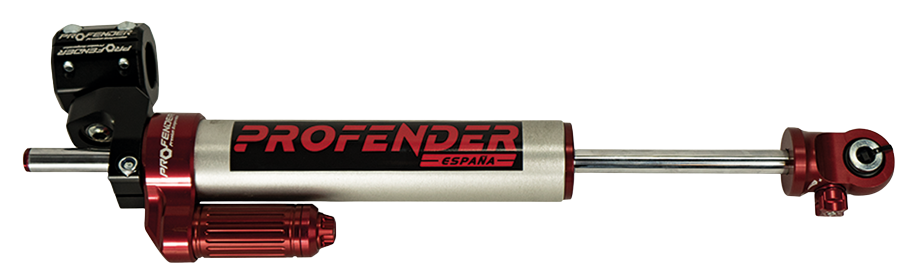
In this post, we will explain what Steering dampers, how to detect when they need to be changed and how to do it yourself; since it's a simple process if you follow the steps we explain below point by point:
Just like all types of shock absorbers, steering dampers are a very important part of your vehicle that ensures your 4x4's grip and the safety of both your vehicle and yourself. Therefore, it is essential to ensure they are functioning correctly.
So the main functions of steering dampers are to temper, maintain the stability of your 4x4 at high speeds, and to protect.
SITUATIONS WHERE STEERING DAMPERS ARE USED

CASE 1.
If, while driving, you hit a pothole with a front wheel that is large enough to alter its trajectory, that wheel will exert a force that can cause a slight jolt in the steering wheel, followed by a more or less slight change of course (depending on the situation) that you will have to correct.
“In this case, the steering damper will brake this unexpected movement, which will give you greater comfort by offering you a smoother and lighter ride, in addition to protecting you against more tense situations. These dampers are key, and even more so if your vehicle is an all-terrain vehicle, as you will drive your 4x4 over complicated terrain with bumps and holes, so good steering dampers are mandatory.”
CASE 2.
In the event of a sudden situation with your all-terrain vehicle, one of the front wheels could hit an obstacle, causing a strong impact that affects the steering, leading to a collision with that wheel.
“In this case, the steering damper will act as a buffer, preventing mechanical breakage.
How to change a steering damper step-by-step?
Replacing a steering damper is a simple and uncomplicated process, even without special equipment or mechanical knowledge. Just buy the damper mount base and you can change it yourself:
- Spray and clean the anti-seize onto the bolts that need to be unscrewed.
On one side of the shock absorber, it is attached to the chassis and on the other to the steering rod:
- On the chassis side, the fixed part of the shock absorber is held by “silent blocks” tightened with bolts onto a threaded part of the shock absorber body.
- On the connecting rod side, the movable part of the shock absorber is hinged on a bolted shaft.
- On the chassis side: Hold the shock absorber in place with a small flat wrench and unscrew both the nut and the locknut.
- Remove the shock absorber from the chassis by compressing it.
- On the connecting rod side: unscrew the shaft with the help of the open-end wrenches and apply counter-pressure.
- The steering damper is generally quite soft, so once you've removed it, you can test it by hand to check that you can compress and extend it, and verify that there are no soft spots or any knocking during compression-extension changes.
- We also recommend that when you change your steering dampers, you take the opportunity to change the silent blocks as well, as this will have a positive effect on the vehicle.
Advantages and disadvantages of hydraulic shock absorbers:
Among the main advantages of hydraulic shock absorbers We found the following:
They just need maintenance
They are not that rigid
They have a sensitive adjustment
They reduce processing times
Among them disadvantages, these include reduced performance on sharp curves and the formation of bubbles when the oil flows from one chamber to another, which hinders the flow.
Every how many kilometers should a steering damper be replaced?
There is no exact mileage for changing steering dampers, as it depends on usage and driving conditions. However, it is recommended to check them every 12,000 to 18,000 miles. Generally, it is advisable to consider replacing them around 50,000 miles, but it is always essential to assess their condition during periodic inspections.
PARTS OF A HYDRAULIC SHOCK ABSORBER
A steering damper typically consists of the following components:
- Outer body or tube: Contains the damping fluid.
- Rod or piston: Moves inside the cylinder and is connected to the steering system.
- Damping valves: They regulate fluid flow to control the shock absorber's response.
- Mountings and brackets: They facilitate the connection of the shock absorber to the vehicle.
- Seals and gaskets: Prevent fluid leaks and maintain internal pressure.
What is a steering damper for?
The steering damper has several key purposes:
- Improve stability: Helps maintain vehicle control on uneven surfaces and at high speeds.
- Reduce steering effort: Minimizes impacts and vibrations at the steering wheel, especially on rough terrain.
- Enhance safety: By improving stability and control, it contributes to the overall safety of the vehicle.
- Protection of other components: Reduces wear on steering system components and suspension by absorbing impacts and vibrations.

Adjustable shock absorbers are shock absorbers that allow you to modify their damping force.
28/02/2020
No Comments

What are air springs?
14/02/2020
No Comments
